

Ozark's Style Maple Syrup: The Region’s Best-Kept Secret!

On a cold February morning in Southern Missouri, steam rises from a small shack tucked among hardwoods. Inside, a pan bubbles slowly, filling the air with the smell of sugar and damp wood. Outside, clear sap drips from metal spouts into plastic buckets, one drop at a time.
This is maple syrup season in the Ozarks—a fact that surprises almost everyone who hears it.
Mention maple syrup, and most Americans picture Vermont hillsides or New England sugar bushes. Southern Missouri rarely enters the conversation. Yet every winter, as temperatures dip below freezing at night and rise just enough during the day, Ozark producers head into the woods to tap sugar maples, silver maples, and even a few native black maples.
The season is short. The work is cold. The yield is modest. And that is exactly why it matters!

(Courtesy: Mass Audubon)
Maple sap gathers in buckets beneath Ozarks trees, the first step in crafting small-batch maple syrup
A Quiet Tradition
Maple syrup has deeper roots in Southern Missouri than many realize. Indigenous peoples and early settlers alike relied on sugar trees as one of the first sweeteners of the year, a welcome source of energy after long winters. In the Ozarks, where subsistence and ingenuity often went hand in hand, syrup was never a novelty—it was practical.
Over time, cheap refined sugar and mass production pushed small-scale syrup making to the margins. What remains today is not industry but intention.
Most Ozark producers tap only a handful of trees. Some do it for family tradition, others for farmers’ markets or small local sales. Few aim to scale up. Sap is collected by hand, boiled down slowly, and bottled in batches that reflect the season that made them.
“This isn’t about volume,” one producer explains, tending the fire beneath his evaporator. “It’s about paying attention.”

(Courtesy: Washington County Insider)
An Ozarks syrup maker walks the trees, tending buckets and monitoring the sap that will soon become maple syrup.
,
The Science of a Short Season.
Maple syrup depends on a precise weather pattern: freezing nights and thawing days. Too warm, and the sap stops flowing. Too cold, and it won’t run at all. In the Ozarks, that window may last only a few weeks—sometimes less.
Climate variability has made the season even more unpredictable. Producers watch forecasts closely, adjusting schedules, sometimes pulling taps early if buds begin to swell. Once the tree prepares to leaf out, the sap turns bitter, and the season ends.
What the Ozarks lack in length, they make up for in flavor. Many describe Ozark maple syrup as darker and more complex, shaped by soil, tree species, and shorter boil times. Each batch tastes slightly different. No two winters are the same.
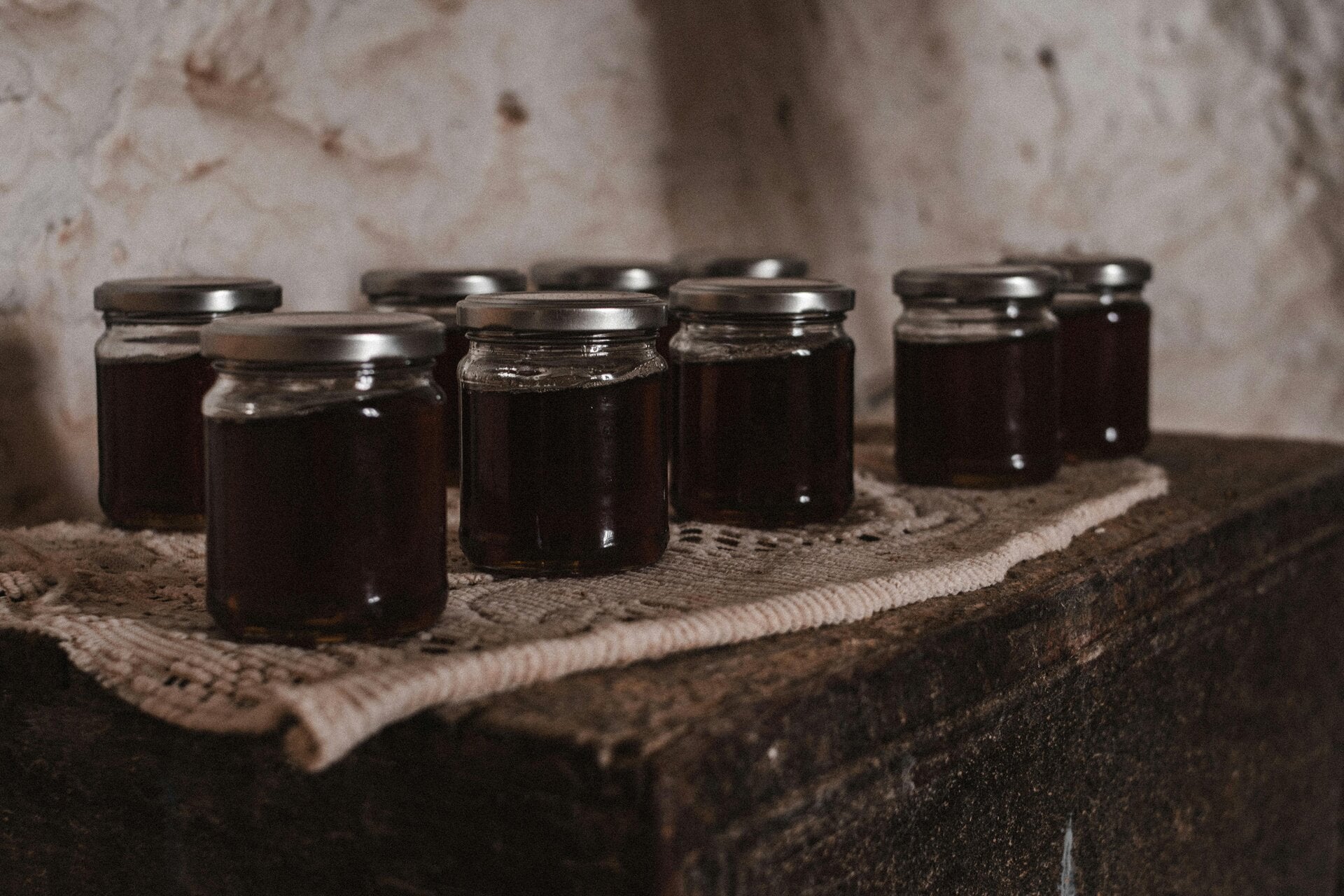
(Courtesy: Pexels)
Black licorice color of Ozarks maple syrup line a shelf, a reward for the season’s work and a nod to old-fashioned preservation.
More Than Pancakes.
Local chefs and bakers have begun to take notice. Ozark maple syrup appears in glazes for roasted meats, in cornbread, and in old-fashioned desserts that favor depth over sweetness. Some producers experiment with maple sugar or syrup aged in bourbon barrels, blending regional traditions into something distinctly Ozark.

(Courtesy: Wholesome Yum)
Ozarks maple syrup adds a glossy finish and deep sweetness to ham, bringing forest-to-table flavor to the plate.
For buyers, the appeal goes beyond taste. Purchasing local syrup supports small landowners and encourages stewardship of hardwood forests. A sugar maple is not something you rush to cut down if it’s producing sap each winter.
“It gives the trees value standing,” says a conservationist familiar with the practice. “That matters.”

(Courtesy: Wikipedia)
A syrup maker checks and tends to sap buckets, continuing a seasonal Ozarks tradition passed down through generations.
A National Story in Miniature.
At a time when Americans are increasingly curious about where their food comes from, Ozark maple syrup offers a quiet counterpoint to industrial systems. It is slow, weather-dependent, and deeply local. There are no shortcuts.

(Courtesy: Pexels)
Golden maple syrup, born at the base of an Ozarks tree, drizzles over toast in a simple, timeless moment.
Nationally, interest in regional foodways and hyperlocal production continues to grow. The Ozarks’ maple syrup story expands the map, reminding consumers that tradition does not belong to one corner of the country.
It also challenges assumptions about the region itself. This is not novelty syrup or a gimmick. It is a continuation of knowledge passed down, adapted, and preserved.

(Courtesy: Stock Cake)
A child waits patiently for a first taste as Ozarks maple syrup is poured over a pancake.